
Sunday, January 2, 2011

Thursday, December 30, 2010

Tuesday, November 9, 2010
Monday, November 1, 2010
Arsenal 1-0 West Ham: Width and Alex finally get Arsenal on Song
Arsenal left it late, but finally got the 3 points home to West Ham.
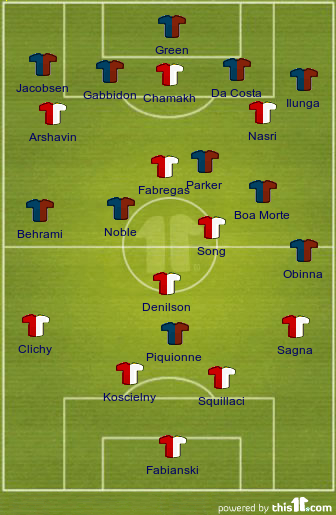
Arsenal named almost the same team that beat Manchester City, with Laurent Koscielny replacing Johan Djourou. With Alex Song operating as a box to box player, Arsenal's formation was something between 4-1-2-3 and 4-2-1-3. West Ham started with only Frederic Piquionne up front, as they named a 5 man midfield to try and stifile Arsenal. Luis Boa Morte was used as a central midfielder, and Valeron Behrami was on the right and Victor Obinna on the left.
 Early Success
Arsenal had early success down the right hand side with Bacary Sagna providing a threat for West Ham. Obinna wasn't tracking back as much as Behrami, who can also play as a wing back and is much more comfortable tracking back than Obinna. Sagna was able to get behind Obinna and put in some dangerous crosses, from which Arsenal failed to score. That, though was it for Arsenal's wide play, as they kept on trying to cut West Ham open through the middle. Last week at City, Arsenal had played with more width, because City were closing them down in the midfield. West Ham were closing Arsenal down, but they were still content to play through the middle, with Song becoming an extra attacking threat.
Song
Over the last few weeks, Alex Song has been at times the most attacking Arsenal midfielder. Last year he was a much more defensively minded midfielder, but this year he has evolved into a box to box midfielder. On Saturday, and last Sunday, Song was partnered with Denilson who is more aware defensively. Against Shakthar Donestk, Wilshere had the job to hold while Song went forward, though it is interesting that Wilshere is though of as a box to box midfielder. On Saturday, the 3 midfielders rotated between holder, box to box and attacking midfielder.
by Guardian Chalkboards
The chalkboard above shows how much his positioning has changed over the last 12 months.
This though means Fabregas plays deeper, not right behind the front man, as he did last year. This maybe because Fabregas has been marked tightly, leading to more space for Song to get forward.
Width
Some of Arsenal's best chances were coming in from wide, with Sagna cutting back for Fabregas and Walcott hitting the post after he came on for Denilson. His pace also forced West Ham to sit deeper, leaving more time for Arsenal to pass the ball around, and letting them get the ball out wide. Eventually, one of Arsenal's crosses found an Arsenal player, with Song scoring after Clichy's excellent cross. Right before, Arshavin had been brought off for Bendtner, getting more bodies in the box, and with the Russian ineffective on this day, Clichy getting forward was important.
Conclusion
A good result for Arsenal; another day and West Ham may have held out for a draw, or even snatched a goal on a set piece or counter. Song was magnificent, going forward and winning the ball back, and again Arsenal scored from wide.
Arsenal named almost the same team that beat Manchester City, with Laurent Koscielny replacing Johan Djourou. With Alex Song operating as a box to box player, Arsenal's formation was something between 4-1-2-3 and 4-2-1-3. West Ham started with only Frederic Piquionne up front, as they named a 5 man midfield to try and stifile Arsenal. Luis Boa Morte was used as a central midfielder, and Valeron Behrami was on the right and Victor Obinna on the left.
Early SuccessArsenal had early success down the right hand side with Bacary Sagna providing a threat for West Ham. Obinna wasn't tracking back as much as Behrami, who can also play as a wing back and is much more comfortable tracking back than Obinna. Sagna was able to get behind Obinna and put in some dangerous crosses, from which Arsenal failed to score. That, though was it for Arsenal's wide play, as they kept on trying to cut West Ham open through the middle. Last week at City, Arsenal had played with more width, because City were closing them down in the midfield. West Ham were closing Arsenal down, but they were still content to play through the middle, with Song becoming an extra attacking threat.
Song
Over the last few weeks, Alex Song has been at times the most attacking Arsenal midfielder. Last year he was a much more defensively minded midfielder, but this year he has evolved into a box to box midfielder. On Saturday, and last Sunday, Song was partnered with Denilson who is more aware defensively. Against Shakthar Donestk, Wilshere had the job to hold while Song went forward, though it is interesting that Wilshere is though of as a box to box midfielder. On Saturday, the 3 midfielders rotated between holder, box to box and attacking midfielder.
by Guardian Chalkboards
The chalkboard above shows how much his positioning has changed over the last 12 months.
This though means Fabregas plays deeper, not right behind the front man, as he did last year. This maybe because Fabregas has been marked tightly, leading to more space for Song to get forward.
Width
Some of Arsenal's best chances were coming in from wide, with Sagna cutting back for Fabregas and Walcott hitting the post after he came on for Denilson. His pace also forced West Ham to sit deeper, leaving more time for Arsenal to pass the ball around, and letting them get the ball out wide. Eventually, one of Arsenal's crosses found an Arsenal player, with Song scoring after Clichy's excellent cross. Right before, Arshavin had been brought off for Bendtner, getting more bodies in the box, and with the Russian ineffective on this day, Clichy getting forward was important.
Conclusion
A good result for Arsenal; another day and West Ham may have held out for a draw, or even snatched a goal on a set piece or counter. Song was magnificent, going forward and winning the ball back, and again Arsenal scored from wide.
Thursday, October 28, 2010
Arsenal 3-0 Manchester City: Width Key and Newcastle 0-4 Arsenal: Counter Attack
Arsenal beat City 3-0 on Sunday, a scoreline that hides the fact that City were in large parts of the game.

After the sending off of Dedryck Boyata, City played a 4-3-1-1 formation, with the 3 sitting very narrow. Arsenal played less through the middle than they did against Birmingham, but on Sunday, Arsenal's wide players, Samir Nasri and Andrey Arshavin kept the width, exposing City, and forcing them to run more. Nasri and Arshavin would combine for the first goal, Nasri cutting in as Bacary Sagna crossed, and Nasri cutting in from the wing provided the ball for Bendtner for the third goal.
A chalkboard explains better than I do:
by Guardian Chalkboards
Against City, Arsenal's passing involved more width than a similar game, away to 10 man Liverpool, did. That may have to do with the different styles of Liverpool and City, but Arsenal's width was a key factor in their victory.
Newcastle 0-4 Arsenal

Arsenal's 4th round Carling Cup victory against Newcastle was a very scrappy and un-Arsenal like performance. Arsenal were sloppy in possession, pehaps down to the pitch, and players like Craig Eastmond in the team, but they seemed to play the long ball more than usual, and Walcott's two goals came from long passes out of defence, though one, by Koscielny, was very composed.
After going 2-0 up, Arsenal sat back a bit, and most of their attacking play in the second half was through the pace of Walcott, as he stretched Newcastle, who were pushing forward to get back into the match. Of the 3 goals in the second half, two were counter attacks, and winning the ball in the middle of the pitch.
Walcott's pace has been missed by Arsenal, as he gives them the pace to lead a quick counter attack, and time and time again a simple long ball from the back found him in a lot of space.
After the sending off of Dedryck Boyata, City played a 4-3-1-1 formation, with the 3 sitting very narrow. Arsenal played less through the middle than they did against Birmingham, but on Sunday, Arsenal's wide players, Samir Nasri and Andrey Arshavin kept the width, exposing City, and forcing them to run more. Nasri and Arshavin would combine for the first goal, Nasri cutting in as Bacary Sagna crossed, and Nasri cutting in from the wing provided the ball for Bendtner for the third goal.
A chalkboard explains better than I do:
by Guardian Chalkboards
Against City, Arsenal's passing involved more width than a similar game, away to 10 man Liverpool, did. That may have to do with the different styles of Liverpool and City, but Arsenal's width was a key factor in their victory.
Newcastle 0-4 Arsenal
Arsenal's 4th round Carling Cup victory against Newcastle was a very scrappy and un-Arsenal like performance. Arsenal were sloppy in possession, pehaps down to the pitch, and players like Craig Eastmond in the team, but they seemed to play the long ball more than usual, and Walcott's two goals came from long passes out of defence, though one, by Koscielny, was very composed.
After going 2-0 up, Arsenal sat back a bit, and most of their attacking play in the second half was through the pace of Walcott, as he stretched Newcastle, who were pushing forward to get back into the match. Of the 3 goals in the second half, two were counter attacks, and winning the ball in the middle of the pitch.
Walcott's pace has been missed by Arsenal, as he gives them the pace to lead a quick counter attack, and time and time again a simple long ball from the back found him in a lot of space.
Thursday, October 21, 2010
Arsenal 5-1 Shakhtar: Arsenal Rout Pitmen
Arsenal are all but through to the knockout stage after thumping Shakhtar Donetsk 5-1.

Arsenal welcomed Cesc Fabregas back and Tomas Rosicky replaced Andrey Arshavin as Arsenal played their usual 4-2-3-1, but with Nasri and Rosicky providing more width than normal. Shakhtar left Douglas Costa and Eduaro on the bench as they went for a more defensive 4-2-3-1.
The match started out slowly, with Arsenal content to sit back and let Shakhtar move the ball around in their own half. Even after going fortuitously up 1-0, they were still content to let Shakhtar move the ball around in defence. Shakhtar, however, were unable to string any coherent play together, and when they did, Arsenal's midfield was quick to press the man in possession.
Midfield Fluidity
The most interesting aspect of Arsenal's play on Tuesday was the fluid midfield of Jack Wilshere, Cesc Fabregas and Alex Song. Last year Song was ofter the most defensive midfielder, and was quite successful; this year he has become more attack minded player, and at times on Tuesday he was the furthest forward midfielder, and at times the deepest. Wilshere and Fabregas would sit back for Song, and it was remarkable how deep Fabregas and Wilshere were at times. After Denilson came on, Wilshere was liberated to move forward, as Denilson was more content to sit back and hold, and Wilshere promptly scored.


It was amazing how deep Arsenal sat back on Tuesday, and somewhat uncharacteristic. Perhaps they were worried about being caught out like they were by Birmingham and West Brom, or maybe they were conserving energy, being confident of there ability to break up play.
Chamakh soon added a 5th, and then Eduardo got a well received consolation to close out an easy game for Arsenal who never looked in danger of losing.
credit to Total Football iPhone App
Arsenal welcomed Cesc Fabregas back and Tomas Rosicky replaced Andrey Arshavin as Arsenal played their usual 4-2-3-1, but with Nasri and Rosicky providing more width than normal. Shakhtar left Douglas Costa and Eduaro on the bench as they went for a more defensive 4-2-3-1.
The match started out slowly, with Arsenal content to sit back and let Shakhtar move the ball around in their own half. Even after going fortuitously up 1-0, they were still content to let Shakhtar move the ball around in defence. Shakhtar, however, were unable to string any coherent play together, and when they did, Arsenal's midfield was quick to press the man in possession.
Midfield Fluidity
The most interesting aspect of Arsenal's play on Tuesday was the fluid midfield of Jack Wilshere, Cesc Fabregas and Alex Song. Last year Song was ofter the most defensive midfielder, and was quite successful; this year he has become more attack minded player, and at times on Tuesday he was the furthest forward midfielder, and at times the deepest. Wilshere and Fabregas would sit back for Song, and it was remarkable how deep Fabregas and Wilshere were at times. After Denilson came on, Wilshere was liberated to move forward, as Denilson was more content to sit back and hold, and Wilshere promptly scored.
It was amazing how deep Arsenal sat back on Tuesday, and somewhat uncharacteristic. Perhaps they were worried about being caught out like they were by Birmingham and West Brom, or maybe they were conserving energy, being confident of there ability to break up play.
Chamakh soon added a 5th, and then Eduardo got a well received consolation to close out an easy game for Arsenal who never looked in danger of losing.
credit to Total Football iPhone App
Monday, October 4, 2010
Chelsea 2-0 Arsenal: Cole and Drogba do it again
Arsenal lost to Chelsea again last Sunday. Despite playing a lot better than they have in the last 4 times, Arsenal still lost, succumbing to the Cole to Drogba yet again.
Arsenal played 4-2-3-1, with Jack Wilshere and Alex Song playing in the deeper midfield role, and Abou Diaby behind Chamakh. Diaby was often ahead of Chamakh early in the match as Arsenal pressed very well in the first 20 minutes, and could've been ahead, with Laurent Koscielny missing over the bar.
Chelsea got back in the match, and took the lead when Cole crossed for Drogba, with Drogba finishing superbly. It was very similar to the goal Drogba scored at the Emirates last year, with Cole getting ahead of Nasri again, and crossing for Drogba again. Emmanuel Eboue may be a solution to stopping Cole, and tracking him. In the end, Arsenal need a player like Ji-Sung Park, who is in the side to specifically track Cole.
by Guardian Chalkboards
Arsenal played well in the second half, dominating possession but never creating enough chances, and when they did, they weren't as clinical as Chelsea. Obviously missing Van Persie and Fabregas hurt Arsenal, but they must be more clinical to win the big matches. Also, there is a defensive wobbly ness about Arsenal; both goals came from fouls that were stupidly conceded.
There isn't a lot more to say. Chelsea were excellent defensively and took their chances very well. There is a machine like efficiency about Chelsea, and they are favourites for the title. However, Arsenal were a lot better than they have been and the game was a lot closer than some pundits have said. There is still a big gap between the two, and tactically, if Arsenal are to beat Chelsea, they will need to have a player who tracks Ashley Cole and prevents him crossing in for Drogba, like he has in 2 of the last 3 meetings.
Arsenal played 4-2-3-1, with Jack Wilshere and Alex Song playing in the deeper midfield role, and Abou Diaby behind Chamakh. Diaby was often ahead of Chamakh early in the match as Arsenal pressed very well in the first 20 minutes, and could've been ahead, with Laurent Koscielny missing over the bar.
Chelsea got back in the match, and took the lead when Cole crossed for Drogba, with Drogba finishing superbly. It was very similar to the goal Drogba scored at the Emirates last year, with Cole getting ahead of Nasri again, and crossing for Drogba again. Emmanuel Eboue may be a solution to stopping Cole, and tracking him. In the end, Arsenal need a player like Ji-Sung Park, who is in the side to specifically track Cole.
by Guardian Chalkboards
Arsenal played well in the second half, dominating possession but never creating enough chances, and when they did, they weren't as clinical as Chelsea. Obviously missing Van Persie and Fabregas hurt Arsenal, but they must be more clinical to win the big matches. Also, there is a defensive wobbly ness about Arsenal; both goals came from fouls that were stupidly conceded.
There isn't a lot more to say. Chelsea were excellent defensively and took their chances very well. There is a machine like efficiency about Chelsea, and they are favourites for the title. However, Arsenal were a lot better than they have been and the game was a lot closer than some pundits have said. There is still a big gap between the two, and tactically, if Arsenal are to beat Chelsea, they will need to have a player who tracks Ashley Cole and prevents him crossing in for Drogba, like he has in 2 of the last 3 meetings.
Monday, September 27, 2010
Arsenal 2-3 West Bromwich Albion: Thomas excellent against Arsenal
Arsenal expected to beat West Brom on Saturday, but instead West Bromwich Albion pulled off a shock, deservedly winning 3-2.
Both teams lined up in a similar 4-2-3-1, with WBA playing with a more compact midfield with the pace of Jerome Thomas on the left and Peter Odimwingie upfront always being a counter attacking threat.
WBA Pressing
West Brom started well and forced a lot of errant passes from Arsenal. This was because of West Brom's pressing, which Roberto Di Matteo revealed later, was there gameplan. They front players didn't give the defenders or defensive midfielders time to pick a pass to one of the attacking players, meaning that Arsenal moves broke down early, or ended up in loss of possession. West Brom's pressing did, however, leave space behind their defence that Arsenal were unable to exploit because of the lack of time to play a killer pass.
Arsenal Defensive Frailties
Arsenal's defence did not have a good game on Saturday. In the first half the defence played a high line, leaving them susceptible to through balls, like the one from Chris Brunt that found Peter Odimwingie and forced a penalty. In the second half, Arsenal were again undone by pace, as Jerome Thomas skinned Bacary Sagna, and crossed for Odimwingie to poke home. It was a good cross and good wing play, but no Arsenal defender tracked the run of Odimwingie. 2 minutes later, Brunt backheeled past Clichy, Koscielny didn't close down Jara and Almunia palmed it into his own net. That was the highlighted error, but just as bad was Koscielny's failure to close down Jara and force him out wide, and also Song's positioning was awful. Wilshere and Rosicky came on for the ineffectual Eboue and Diaby and Vela came on for Koscielny. WBA then scored again, Brunt evading Song's challenge and beating Almunia to the ball before crossing for Thomas to tap in. It was again poor goalkeeping by Almunia, but again not one defender tracked the run of Thomas and Song's defending was again poor.
Nasri immiedietly responded for Arsenal, who started to look more dangerous. Arshavin came into the center, Nasri had a drifting role, with Vela trying to cross from the left. Wilshere came on for Diaby and played a lot better than the Frenchman had, though WBA did allow more space as they sat back. Nasri would score again, but Arsenal were unable to score a third.
Conclusion
Arsenal were undone by pace and pressing today. West Brom pressedm rather like Sunderland did last week. Both teams didn't allow Arsenal time on the ball, which meant that Arsenal didn't really start to dominate until later in the match when the opposition tired. Arsenal will have to find some way to relieve the pressure. One way to relieve pressure is pace, and it would've been interesting to see if the pace of Walcott could've exploited the space behind West Brom's back line.
Arsenal's high defensive line meant they were susceptible to the pace of Thomas and Odemwingie, and it was those two, along with Chris Brunt, that caused the most damage for Arsenal. The fullbacks were paticularly bad, with Thomas and Brunt regularly getting the better of Sagna and Clichy. Whatever may happen in the following months for West Brom, this was a match they thoroughly deserved to win.
Both teams lined up in a similar 4-2-3-1, with WBA playing with a more compact midfield with the pace of Jerome Thomas on the left and Peter Odimwingie upfront always being a counter attacking threat.
WBA Pressing
West Brom started well and forced a lot of errant passes from Arsenal. This was because of West Brom's pressing, which Roberto Di Matteo revealed later, was there gameplan. They front players didn't give the defenders or defensive midfielders time to pick a pass to one of the attacking players, meaning that Arsenal moves broke down early, or ended up in loss of possession. West Brom's pressing did, however, leave space behind their defence that Arsenal were unable to exploit because of the lack of time to play a killer pass.
Arsenal Defensive Frailties
Arsenal's defence did not have a good game on Saturday. In the first half the defence played a high line, leaving them susceptible to through balls, like the one from Chris Brunt that found Peter Odimwingie and forced a penalty. In the second half, Arsenal were again undone by pace, as Jerome Thomas skinned Bacary Sagna, and crossed for Odimwingie to poke home. It was a good cross and good wing play, but no Arsenal defender tracked the run of Odimwingie. 2 minutes later, Brunt backheeled past Clichy, Koscielny didn't close down Jara and Almunia palmed it into his own net. That was the highlighted error, but just as bad was Koscielny's failure to close down Jara and force him out wide, and also Song's positioning was awful. Wilshere and Rosicky came on for the ineffectual Eboue and Diaby and Vela came on for Koscielny. WBA then scored again, Brunt evading Song's challenge and beating Almunia to the ball before crossing for Thomas to tap in. It was again poor goalkeeping by Almunia, but again not one defender tracked the run of Thomas and Song's defending was again poor.
Nasri immiedietly responded for Arsenal, who started to look more dangerous. Arshavin came into the center, Nasri had a drifting role, with Vela trying to cross from the left. Wilshere came on for Diaby and played a lot better than the Frenchman had, though WBA did allow more space as they sat back. Nasri would score again, but Arsenal were unable to score a third.
Conclusion
Arsenal were undone by pace and pressing today. West Brom pressedm rather like Sunderland did last week. Both teams didn't allow Arsenal time on the ball, which meant that Arsenal didn't really start to dominate until later in the match when the opposition tired. Arsenal will have to find some way to relieve the pressure. One way to relieve pressure is pace, and it would've been interesting to see if the pace of Walcott could've exploited the space behind West Brom's back line.
Arsenal's high defensive line meant they were susceptible to the pace of Thomas and Odemwingie, and it was those two, along with Chris Brunt, that caused the most damage for Arsenal. The fullbacks were paticularly bad, with Thomas and Brunt regularly getting the better of Sagna and Clichy. Whatever may happen in the following months for West Brom, this was a match they thoroughly deserved to win.
Wednesday, September 15, 2010
Fabulous Fabregas leads Arsenal in 6-0 thrashing
Cesc Fabregas was spectacular against Braga on Wednesday night; from his position in a 4-2-1-3/4-2-3-1 he dictated play, and was involved in all 6 goals for Arsenal. Arsenal lined up similarly to Saturday, in a 4-2-3-1 with Samir Nasri drifting in a lot, making the 4-2-3-1 become a 4-2-2-2 when either Arshavin or Fabregas pushed on. Braga also lined up in a 4-2-3-1, but a wider and deeper 4-2-3-1 than Arsenal's.
Arsenal started the game off extremely strong and were pressing the ball and passing the ball extremely well and could've had a penalty 3 minutes in. The breakthrough finally came through, and it was Fabregas playing in Chamakh.
All Through the Left
A lot of Arsenal's attacking play came through the left; with Samir Nasri replacing the injured Theo Walcott, Arsenal lacked width as Nasri liked the come inside. This was pointed out last week where I mentioned that Arsenal seemed to be playing a 4-2-2-2 at times. Tonight it looked like a diamond 4-4-2, with Wilshere, though at times defending deep, given license to move forward on the left of midfield, and with Arshavin prefering the left.
 (Picture from soccernet.com. Arsenal's defenders are in red, Alex Song is the deepest midfielder, Wilshere and Nasri play on the left and right of the centre midfield, with Fabregas playing ahead of them, behind Chamakh and Arshavin (in black)).
Braga's strongest player was Alan, but as he was on their right, most of their attacks came down their right where Arsenal were strong in numbers, while if they had switched to the left, Arsenal could've been more exposed.
The Joy of Cesc
Braga found it difficult to mark Fabregas, as he was constantly moving between the lines. Fabregas was everywhere, either coming from deep, or appearing at times higher than Marouane Chamakh, and Braga couldn't cope with Fabregas' great all around play. Not only did he have 2 assists and 2 goals, but his pressing was very good, creating his second goal from it.
Chamakh's movement was again key for Arsenal, as he dragged defenders, creating space for both Fabregas and Arshavin.
Arsenal won't find many games easier than this, but it was still a fine attacking performance, and when called upon, they defended well. As Thomas Vermaelen pointed out, Koscielny "goes for the close marking style" and Squillaci is similar. This, as well as defending deep, countered Braga's counter attack threat. All in all, an excellent, joyful performance from Arsenal, and one that should make clubs across Europe take notice.
Arsenal lined up similarly to Saturday, in a 4-2-3-1 with Samir Nasri drifting in a lot, making the 4-2-3-1 become a 4-2-2-2 when either Arshavin or Fabregas pushed on. Braga also lined up in a 4-2-3-1, but a wider and deeper 4-2-3-1 than Arsenal's.Arsenal started the game off extremely strong and were pressing the ball and passing the ball extremely well and could've had a penalty 3 minutes in. The breakthrough finally came through, and it was Fabregas playing in Chamakh.
All Through the Left
A lot of Arsenal's attacking play came through the left; with Samir Nasri replacing the injured Theo Walcott, Arsenal lacked width as Nasri liked the come inside. This was pointed out last week where I mentioned that Arsenal seemed to be playing a 4-2-2-2 at times. Tonight it looked like a diamond 4-4-2, with Wilshere, though at times defending deep, given license to move forward on the left of midfield, and with Arshavin prefering the left.
 (Picture from soccernet.com. Arsenal's defenders are in red, Alex Song is the deepest midfielder, Wilshere and Nasri play on the left and right of the centre midfield, with Fabregas playing ahead of them, behind Chamakh and Arshavin (in black)).
Braga's strongest player was Alan, but as he was on their right, most of their attacks came down their right where Arsenal were strong in numbers, while if they had switched to the left, Arsenal could've been more exposed.
The Joy of Cesc
Braga found it difficult to mark Fabregas, as he was constantly moving between the lines. Fabregas was everywhere, either coming from deep, or appearing at times higher than Marouane Chamakh, and Braga couldn't cope with Fabregas' great all around play. Not only did he have 2 assists and 2 goals, but his pressing was very good, creating his second goal from it.
Chamakh's movement was again key for Arsenal, as he dragged defenders, creating space for both Fabregas and Arshavin.
Arsenal won't find many games easier than this, but it was still a fine attacking performance, and when called upon, they defended well. As Thomas Vermaelen pointed out, Koscielny "goes for the close marking style" and Squillaci is similar. This, as well as defending deep, countered Braga's counter attack threat. All in all, an excellent, joyful performance from Arsenal, and one that should make clubs across Europe take notice.
Sunday, September 12, 2010
Are Arsenal playing a 4-2-2-2?
With the absence of Theo Walcott, Tomas Rosicky came into the first XI on Saturday. Rosicky is a different player to Walcott, and looks to come inside more than Walcott.
At times, it looked like Arsenal were playing a Spanish like 4-2-3-1/4-2-2-2, with Rosicky joining Fabregas.
Let's look at the 3rd Arsenal goal
 Here, Rosicky and Denilson (black underlined) are the 2 deepest midfielders, while Fabregas and Song (in red) are the two furthest. Arshavin is out of picture, and Chamakh is in green.
With Rosicky tucking in, there's noone on the right wing, and Arshavin is on the left, but drifting in. This is similar to Spain's system early in the World Cup; Villa nominally on the left but cutting in, Torres up front, Iniesta nominally on the right cutting in to the middle with Xavi and Sergio and Alonso holding. It's a similar system here (though Song is not an attacking midfielder)
 Here, Arshavin has joined the attack, giving Arsenal 2 defined front players and 2 defined attacking midfielders. To me, the formation seems a 4-2-2-2. While that formation can create natural width by players finding space, and some wonderful football (it was used by Brazil in 1982), the lack of a direct outlet on the right could hinder Arsenal, which is why it's important the fullbacks can deliver good crosses when they do get forward, or Arsenal have a direct outlet like Walcott available.
At times, it looked like Arsenal were playing a Spanish like 4-2-3-1/4-2-2-2, with Rosicky joining Fabregas.
Let's look at the 3rd Arsenal goal
 Here, Rosicky and Denilson (black underlined) are the 2 deepest midfielders, while Fabregas and Song (in red) are the two furthest. Arshavin is out of picture, and Chamakh is in green.
With Rosicky tucking in, there's noone on the right wing, and Arshavin is on the left, but drifting in. This is similar to Spain's system early in the World Cup; Villa nominally on the left but cutting in, Torres up front, Iniesta nominally on the right cutting in to the middle with Xavi and Sergio and Alonso holding. It's a similar system here (though Song is not an attacking midfielder)
 Here, Arshavin has joined the attack, giving Arsenal 2 defined front players and 2 defined attacking midfielders. To me, the formation seems a 4-2-2-2. While that formation can create natural width by players finding space, and some wonderful football (it was used by Brazil in 1982), the lack of a direct outlet on the right could hinder Arsenal, which is why it's important the fullbacks can deliver good crosses when they do get forward, or Arsenal have a direct outlet like Walcott available.
Chamakh Attack: Chamakh's movement key in 4-1 victory
Arsenal got all 3 points today in a fully deserved 4-1 victory against Bolton, though credit to Bolton as they made it very difficult for Arsenal.

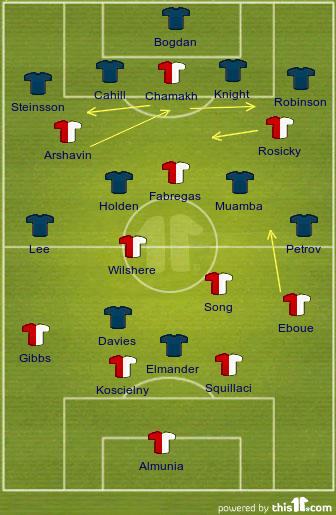
Kieran Gibbs, Emmanuel Eboue, Sebastien Squillaci, Jack Wilshere and Tomas Rosicky came in for Arsenal, replacing Clichy, Sagna, Vermaelen, Diaby and Walcott from last week as they went for their standard 4-2-3-1/4-1-2-3 formation. With internationals behind and Champions League matches coming, Arsene Wenger went for a very attack minded defence, with Eboue and Gibbs two fullbacks who can also play as wingers. Bolton played a standard 4-4-2, with Holden and Muamba two more defensively minded midfielders.
Bolton started off strongly, with the aerial threat creating a couple of half chances, and were always a danger from set pieces, Arsenal however dealt with it, and their passing settled down.
Marouane Chamakh had a paticulary good game for Arsenal; his movement and build up play was very good, and he was willing to drift out wide. This allowed Arshavin to come inside, which he preferes, and Rosicky and Fabregas played killer passes for Arshavin on numerous occasions. He couldn't finish any of them, though he did win the corner that led to the opening goal. It could've been two when Chamakh, drifting to the left, played a great ball that Wilshere dummied for Rosicky, coming inside, weakly shot and was easily saved by Bogdan.
It was interesting to see Rosicky, the nominal right midfielder, come inside a lot, creating a formation that looked sometimes more like 4-2-2-2, very narrow. Eboue was trying his best to get forward on the right, but at times in the first half, Arsenal missed Walcott's direct outlet on the right.
A defensive error meant Arsenal went in level, but that was soon changed, when Fabregas took advantage of Bolton's sometimes suicidal high line yesterday to play a great ball over the top for Chamakh. The striker's shot was parried by Bogdan, but from the ensuing corner that wasn't completely cleared, Chamakh scored with his head after an excellent Fabregas cross.
It was Chamakh drifting out wide when he flicked the ball on for Arshavin and was taken out by Gary Cahill, who got sent off.
Song had a much more prominent role in the second half goign forward, and after excellent work from Arshavin, Song cheeklily chipped Bogdan for the third, and the 1000th under Arsene Wenger.
The fourth was an excellent goal. Vela won the ball, and the 24 passes later scored after a great Fabregas goal.

Not a very interesting game, tactically; Arsenal were the much better side, and deserved the 3 points. The only not of interest was that Rosicky was tucking in quite a lot, and switching with Fabregas so that Fabregas would play deeper and Rosicky more forward, or Rosicky deeper and Fabregas more forward. It created an assymetrical 4-2-2-2, which while it worked today as Bolton played a quite high line, against better defensive teams, the lack of width could hurt Arsenal. Chamakh is quite a good header of the ball, and so having width and crossing into Chamakh could be a successful way to goal for Arsenal.
Kieran Gibbs, Emmanuel Eboue, Sebastien Squillaci, Jack Wilshere and Tomas Rosicky came in for Arsenal, replacing Clichy, Sagna, Vermaelen, Diaby and Walcott from last week as they went for their standard 4-2-3-1/4-1-2-3 formation. With internationals behind and Champions League matches coming, Arsene Wenger went for a very attack minded defence, with Eboue and Gibbs two fullbacks who can also play as wingers. Bolton played a standard 4-4-2, with Holden and Muamba two more defensively minded midfielders.
Bolton started off strongly, with the aerial threat creating a couple of half chances, and were always a danger from set pieces, Arsenal however dealt with it, and their passing settled down.
Marouane Chamakh had a paticulary good game for Arsenal; his movement and build up play was very good, and he was willing to drift out wide. This allowed Arshavin to come inside, which he preferes, and Rosicky and Fabregas played killer passes for Arshavin on numerous occasions. He couldn't finish any of them, though he did win the corner that led to the opening goal. It could've been two when Chamakh, drifting to the left, played a great ball that Wilshere dummied for Rosicky, coming inside, weakly shot and was easily saved by Bogdan.
It was interesting to see Rosicky, the nominal right midfielder, come inside a lot, creating a formation that looked sometimes more like 4-2-2-2, very narrow. Eboue was trying his best to get forward on the right, but at times in the first half, Arsenal missed Walcott's direct outlet on the right.
A defensive error meant Arsenal went in level, but that was soon changed, when Fabregas took advantage of Bolton's sometimes suicidal high line yesterday to play a great ball over the top for Chamakh. The striker's shot was parried by Bogdan, but from the ensuing corner that wasn't completely cleared, Chamakh scored with his head after an excellent Fabregas cross.
It was Chamakh drifting out wide when he flicked the ball on for Arshavin and was taken out by Gary Cahill, who got sent off.
Song had a much more prominent role in the second half goign forward, and after excellent work from Arshavin, Song cheeklily chipped Bogdan for the third, and the 1000th under Arsene Wenger.
The fourth was an excellent goal. Vela won the ball, and the 24 passes later scored after a great Fabregas goal.

Not a very interesting game, tactically; Arsenal were the much better side, and deserved the 3 points. The only not of interest was that Rosicky was tucking in quite a lot, and switching with Fabregas so that Fabregas would play deeper and Rosicky more forward, or Rosicky deeper and Fabregas more forward. It created an assymetrical 4-2-2-2, which while it worked today as Bolton played a quite high line, against better defensive teams, the lack of width could hurt Arsenal. Chamakh is quite a good header of the ball, and so having width and crossing into Chamakh could be a successful way to goal for Arsenal.
Sunday, August 29, 2010
Brilliant defensive performance gives Arsenal victory
Blackburn away is a tricky venue for Arsenal, especially as they are managed by Sam Allardyce, a manager whose tactics had frustrated Arsenal over the years. Today, despite the aerial and physical game played, Arsenal came away with all 3 points in a 2-1 victory.

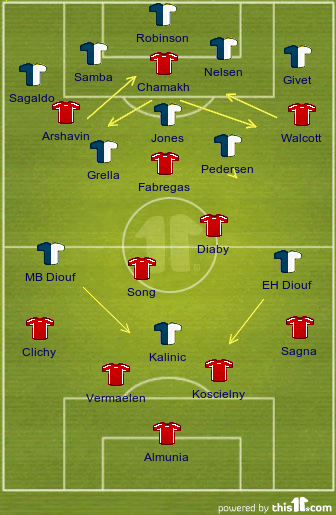
Cesc Fabregas and Robin Van Persie returned to the starting XI for the first time in the new campaign, while Laurent Koscielny returned from suspension. Unlike the previous 2 games, though, Arsenal's shape was more like a 4-2-1-3 or a 4-1-2-3, instead of the 4-2-3-1. Fabregas quite often came deep, and so too did Chamakh and Van Persie, which allowed Walcott and Arshavin to take up the space vacated by the centre forward, which is how the opening goal came about. Walcott and Arshavin pressed high up the pitch, and as well as scoring 1 goal, Walcott's intelligent run created space for Sagna for the second goal, and had a good game all around.
Blackburn set out to frustrate Arsenal, and matched Arsenal with a 4-3-3, with Jones sitting right in front of the defence and Grella and Pedersen also holding. Mame Biriam Diouf and El-Hadji Diouf played on the wings and looked to cut into the box when possible.
Blackburn played their direct long ball style, attempting only 200 passes in the whole game, and difference in styles is shown below
by Guardian Chalkboards
Blackburn didn't really bother playing through the midfield, while Arsenal did; the Arsenal goals came after 7 pass moves each, and the Blackburn goal came after a 2 pass move.
Defensively, Arsenal were fairly solid and dealed with the long ball and long throw threat of Blackburn. Koscielny may have been at fault for the first goal, but for the rest of the match he was fantastic, with him and Vermaelen only losing 4 duels, with Koscielny winning most of his aerial duels.
by Guardian Chalkboards
Arsenal deserved the 3 points, and they quite easily could've had a third that reflected the dominance they had in the midfield in the second half, as their possession football strangled the game and coupled with Arsenal's aerial security (Blackburn winning only 4 of their long throws and corners) made it hard for Blackburn to create chances. If Arsenal can continue to create this kind of performance at away venues like Blackburn, Stoke, Birmingham, Bolton and Sunderland, it could go a long way in the title race.
Cesc Fabregas and Robin Van Persie returned to the starting XI for the first time in the new campaign, while Laurent Koscielny returned from suspension. Unlike the previous 2 games, though, Arsenal's shape was more like a 4-2-1-3 or a 4-1-2-3, instead of the 4-2-3-1. Fabregas quite often came deep, and so too did Chamakh and Van Persie, which allowed Walcott and Arshavin to take up the space vacated by the centre forward, which is how the opening goal came about. Walcott and Arshavin pressed high up the pitch, and as well as scoring 1 goal, Walcott's intelligent run created space for Sagna for the second goal, and had a good game all around.
Blackburn set out to frustrate Arsenal, and matched Arsenal with a 4-3-3, with Jones sitting right in front of the defence and Grella and Pedersen also holding. Mame Biriam Diouf and El-Hadji Diouf played on the wings and looked to cut into the box when possible.
Blackburn played their direct long ball style, attempting only 200 passes in the whole game, and difference in styles is shown below
by Guardian Chalkboards
Blackburn didn't really bother playing through the midfield, while Arsenal did; the Arsenal goals came after 7 pass moves each, and the Blackburn goal came after a 2 pass move.
Defensively, Arsenal were fairly solid and dealed with the long ball and long throw threat of Blackburn. Koscielny may have been at fault for the first goal, but for the rest of the match he was fantastic, with him and Vermaelen only losing 4 duels, with Koscielny winning most of his aerial duels.
by Guardian Chalkboards
Arsenal deserved the 3 points, and they quite easily could've had a third that reflected the dominance they had in the midfield in the second half, as their possession football strangled the game and coupled with Arsenal's aerial security (Blackburn winning only 4 of their long throws and corners) made it hard for Blackburn to create chances. If Arsenal can continue to create this kind of performance at away venues like Blackburn, Stoke, Birmingham, Bolton and Sunderland, it could go a long way in the title race.
Thursday, August 19, 2010
Subsittutes change the game for Arsenal
It took Arsenal a long time to break down the organised Liverpool defence on Sunday afternoon, but the introduction of Robin van Persie, Tomas Rosicky and Theo Walcott changed the game for the Gunners.
The introduction of that trio gave Arsenal more options, and Arsenal got the ball into the box more after Rosicky came on, replacing the ineffectual Wilshere.
by Guardian Chalkboards
Here, the introduction of Theo Walcott gave Arsenal a more direct outlet on the right, and, coupled with Walcott's pace, it forced Liverpool to defend deeper, making more space for Arsenal to work in.
by Guardian Chalkboards
Finally, the introduction of Van Persie meant that he became the link up forward off Chamakh, leaving Chamakh the target man, leading to the goal that Arsenal scored.
On a defensive note, Laurent Koscielny had a superb game for Arsenal; he won 5 out of 6 tackles (including 4 out of 5 in the air) made 4 out of 5 clearaances successfully, and his passing from the back was superb, with his 1 unsuccessful pass coming in Liverpool's penalty box. It was a superb debut for the Frenchman, who gives Arsenal the kind of centre-half that they need.
by Guardian Chalkboards
The introduction of that trio gave Arsenal more options, and Arsenal got the ball into the box more after Rosicky came on, replacing the ineffectual Wilshere.
by Guardian Chalkboards
Here, the introduction of Theo Walcott gave Arsenal a more direct outlet on the right, and, coupled with Walcott's pace, it forced Liverpool to defend deeper, making more space for Arsenal to work in.
by Guardian Chalkboards
Finally, the introduction of Van Persie meant that he became the link up forward off Chamakh, leaving Chamakh the target man, leading to the goal that Arsenal scored.
On a defensive note, Laurent Koscielny had a superb game for Arsenal; he won 5 out of 6 tackles (including 4 out of 5 in the air) made 4 out of 5 clearaances successfully, and his passing from the back was superb, with his 1 unsuccessful pass coming in Liverpool's penalty box. It was a superb debut for the Frenchman, who gives Arsenal the kind of centre-half that they need.
by Guardian Chalkboards
Tuesday, July 13, 2010
Barcelona Have Acted Disgracefully, and We Should Ignore Them
Since the Cesc Fabregas transfer saga broke, FC Barcelona have been utterly disrespectful to Arsenal and despicable.
When Fabregas allegedly told Arsene Wenger he wanted to leave for FC Barcelona, he said he wanted his future sorted before the World Cup. In an effort to drive down his price, Joan Laporta encouraged him to go public with his alleged desire to leave Arsenal. Technically, Laporta having this sort of contact while Fabregas is under contract at Arsenal is tapping up, which Barcelona have done throughout this whole saga. Barcelona then made an insultingly low bid of £29 million. They claimed that they would pay no more, because Fabregas was "stolen" from them by Arsenal and developed at Barcelona.
2 points about that: 1. It was well within FIFA rules for Arsenal to sign him when he was 16. He had no contract at Barcelona, and was worried that he wouldn't play. 2: Barcelona are only doing this because he became an excellent player. It's like Xavi is claiming Fran Merida has Barca DNA.
Despite Arsenal being clear about their refusal to enter negotiations, Barcelona continued their underhand approach to our captain. They went to the press claiming they had agreed personal terms. Every day it seemed a press release would be on the official website claiming the deal would be done. Barcelona's players went to the press talking about Barca DNA and what not. Finally, yesterday, during the Spanish celebration, Pique and Puyol forced a Barca shirt on Cesc. To be fair to Cesc he never enetered into bullshit discussion. He wanted his teammates to shut up. He said how great Arsenal and Arsene Wenger are. And he took the Barca shirt off. It's became painfully clear what Barca want: They want Cesc as a trophy, and they want to bully there way to get him because they are in serious debt.
Last week they made a loan for €150 m. According to this article, they are in €392m of debt. Joan Laporta and Sandro Rosell knew this. However, instead of saying to Cesc that they couldn't afford him, but they could in the future, they used the press to destablilze Cesc at the club. My belief is that someone at Barca told Puyol and Pique to put the shirt on him. Why else would it be on their official site? Despite saying they would respect Arsenal, they haven't at all. They've gone to the press, complained that the press drove the price up and have tried to bully their way to buying Cesc Fabregas. Arsenal have repeatedly said he is not for sale; Arsene Wenger refused to meet with Sandro Rosell.
My advice to fellow fans is to ignore everything about Cesc unless it comes from Cesc himself or Arsenal. And I hope very much that Arsenal report Barcelona for tapping up and break off relations with Barcelona. If Cesc puts in a transfer request, he doesn't have to be sold to Barcelona. He could always be sold to Real Madrid, which would be Barcelona's (Or the Catalan Real Madrid) worst nightmare.
When Fabregas allegedly told Arsene Wenger he wanted to leave for FC Barcelona, he said he wanted his future sorted before the World Cup. In an effort to drive down his price, Joan Laporta encouraged him to go public with his alleged desire to leave Arsenal. Technically, Laporta having this sort of contact while Fabregas is under contract at Arsenal is tapping up, which Barcelona have done throughout this whole saga. Barcelona then made an insultingly low bid of £29 million. They claimed that they would pay no more, because Fabregas was "stolen" from them by Arsenal and developed at Barcelona.
2 points about that: 1. It was well within FIFA rules for Arsenal to sign him when he was 16. He had no contract at Barcelona, and was worried that he wouldn't play. 2: Barcelona are only doing this because he became an excellent player. It's like Xavi is claiming Fran Merida has Barca DNA.
Despite Arsenal being clear about their refusal to enter negotiations, Barcelona continued their underhand approach to our captain. They went to the press claiming they had agreed personal terms. Every day it seemed a press release would be on the official website claiming the deal would be done. Barcelona's players went to the press talking about Barca DNA and what not. Finally, yesterday, during the Spanish celebration, Pique and Puyol forced a Barca shirt on Cesc. To be fair to Cesc he never enetered into bullshit discussion. He wanted his teammates to shut up. He said how great Arsenal and Arsene Wenger are. And he took the Barca shirt off. It's became painfully clear what Barca want: They want Cesc as a trophy, and they want to bully there way to get him because they are in serious debt.
Last week they made a loan for €150 m. According to this article, they are in €392m of debt. Joan Laporta and Sandro Rosell knew this. However, instead of saying to Cesc that they couldn't afford him, but they could in the future, they used the press to destablilze Cesc at the club. My belief is that someone at Barca told Puyol and Pique to put the shirt on him. Why else would it be on their official site? Despite saying they would respect Arsenal, they haven't at all. They've gone to the press, complained that the press drove the price up and have tried to bully their way to buying Cesc Fabregas. Arsenal have repeatedly said he is not for sale; Arsene Wenger refused to meet with Sandro Rosell.
My advice to fellow fans is to ignore everything about Cesc unless it comes from Cesc himself or Arsenal. And I hope very much that Arsenal report Barcelona for tapping up and break off relations with Barcelona. If Cesc puts in a transfer request, he doesn't have to be sold to Barcelona. He could always be sold to Real Madrid, which would be Barcelona's (Or the Catalan Real Madrid) worst nightmare.
Friday, June 25, 2010
Should India Do Better?
According to the excellent book Why England Lose or Soccernomics in the United States, countries that have large populations and good economies should do well in international football. This brings the question, why have India only qualified for 1 World Cup, which they didn't even play in? India has a large population and a fairly good economy despite high poverty levels. What gives?
According to Why England Loses, and regression research done by the authors, twice the population is worth .1 goal, twice the GDP is worth .1 goal, and having twice the experience is worth .5 goals.
To tally the goal scoring, you figure out the ratio of, for example, population of country/population of opposition and multiply the coefficient for either population, GDP or experience. For population and GDP, the coefficient is .05, for experience, it is .25.
According to Russell Gerrard's database, between 1871 and 2001, India had played 244 international football matches. I will compare India with the country that has qualified the most for the World Cup, South Korea, and with Iran, who have qualified 3 times and won the Asian Cup 3 times.
India have a massive advantage in population, 1.2 goals. South Korea has .4 goal advantage in GDP and .6 in experience. India should win by .2 goals, meaning most games between the 2 should end in a draw. So we know India should draw with South Korea. Should they've qualified for the World Cup?
In the first round they lost to Lebanon 6-3 on aggregate; using the same method described earlier, India should be beating Lebanon by 14.5 goals, with a massive 13 of them coming from the superiority in population. Over 2 legs, that should be 29 goals, instead of losing by the 3 goals they did. Replacing Lebanon in Group 4, they should beat Uzbekistan at home (.67 goals for home field advantage) by 3.8 goals at home, and 2.43 goals away. Against Saudi Arabia
According to Why England Loses, and regression research done by the authors, twice the population is worth .1 goal, twice the GDP is worth .1 goal, and having twice the experience is worth .5 goals.
To tally the goal scoring, you figure out the ratio of, for example, population of country/population of opposition and multiply the coefficient for either population, GDP or experience. For population and GDP, the coefficient is .05, for experience, it is .25.
According to Russell Gerrard's database, between 1871 and 2001, India had played 244 international football matches. I will compare India with the country that has qualified the most for the World Cup, South Korea, and with Iran, who have qualified 3 times and won the Asian Cup 3 times.
India have a massive advantage in population, 1.2 goals. South Korea has .4 goal advantage in GDP and .6 in experience. India should win by .2 goals, meaning most games between the 2 should end in a draw. So we know India should draw with South Korea. Should they've qualified for the World Cup?
In the first round they lost to Lebanon 6-3 on aggregate; using the same method described earlier, India should be beating Lebanon by 14.5 goals, with a massive 13 of them coming from the superiority in population. Over 2 legs, that should be 29 goals, instead of losing by the 3 goals they did. Replacing Lebanon in Group 4, they should beat Uzbekistan at home (.67 goals for home field advantage) by 3.8 goals at home, and 2.43 goals away. Against Saudi Arabia
they should beat them at home by 2 goals, and win away by .7 goals (anything less than .5 is about a draw). Moving on to playing Singapore, which, having a small population and less experience than India, loses by 12.2 goals to India away and by 10.8 goals at home. India, having won all 6 games, have 18 points and a goal difference of 32.
They are then drawn into Group B, with South Korea, North Korea, Iran and the UAE.
We already know in a neutral venue they should beat South Korea by .2 goals. Adding home field advantage, they'll beat South Korea by .9 goals at home, but lose by .5 goals away, which is effectively a draw. Against North Korea, they should win by 3.7 goals at home and by 2.3 goals away. Against Iran they win by 1 goal at home, and draw away. Finally, against the UAE they should win by 9.8 goals at home and by 8.5 goals away. Tallying up the results, India would finish with 20 points and a goal difference of 25. If this happened, they would qualify for the 2010 FIFA World Cup.
India should do better. In Why England Lose, they were one of the underachievers based on population, GDP and experience. India can create a good football team if they create a good league, which they can do for cricket, as they did for the Indian Premier League. Based on this, India should become a powerhouse team in Asia, and could possibly win the World Cup in the future.
Thursday, June 24, 2010
Best League In the World Series™: Oceania
Continuing the Best League In the World™ after a long break, we are on to Oceania.
Oceania is not a very competitive country footballing wise, having sent just 4 finalists to the World Cup.
In terms of entertainment, the Solomon Islands wins the crown for Oceania; with a low standard deviation and a high number of goals, it ranked first in Oceania.
The Table is here.
Oceania is not a very competitive country footballing wise, having sent just 4 finalists to the World Cup.
In terms of entertainment, the Solomon Islands wins the crown for Oceania; with a low standard deviation and a high number of goals, it ranked first in Oceania.
The Table is here.
Friday, June 18, 2010
England: Antoher simile for "rubbish"
England drew 0-0 with Algeria, and were desperately poor. It was a distressing result, with many expecting England to play better against Algeria, who were not very good against Slovenia.
 As this graph shows, England had a lot of passes in the midfield and back, but in the final third, but also a lot down the middle. Algeria, playing a 3-4-2-1 when in possession, 5-4-1 when not, had 5 players in the center, the 3 centre backs and 2 midfielders.
One reason the middle of the park was so congested was the positioning of Steven Gerrard. Gerrard was nominally the left midfield player, cutting inside for Ashley Cole to bomb forward. However, as the graphic below shows, instead of cutting in, he occupied the same area of space as Wayne Rooney, Gareth Barry and Frank Lampard.
 In previous tournaments, one of England's problems was that Gerrard and Lampard couldn't play together (Is it no coincidence that in England's best performance of the last world cup, 2-2 against Sweden, Gerrard didn't start?). Under Capello, the problem remains, though, with Barry as the holding midfielder, neither has the responsibility to defend. Neither had a good game; as with the with rest of the England team, they were desperately poor, and the incident where Lampard failed to successfully pass to Gerrard 10 yards away inside the first 20 seconds set the tone for the whole match. The match was desperately callinh out for someone who could deliver an incisve pass, yet just as in the US game, Joe Cole sat on the bench and watched Shaun Wright-Phillips and Peter Crouch come on instead of him. Joe Cole has to start against Slovenia instead of Gerrard or Lampard. Capello might not like him because he cuts inside; yet Gerrard does the same thing and passes the ball better.
Another player who should start is Michael Carrick. He might not have had a great domestic season, but he and Joe Cole are the closes players England have to good technical players, and after the performance put in tonight, technicality is needed.
Credit is due where it's deserved: Algeria defended exceptionally well and made it difficult for England to break them down. They were looking for a point, with the possibility of getting a goal on the break. As stated earlier, playing a 3-4-2-1 meant that when England came down the middle, they were well prepared to defend.
Conclusion:
England were extremely poor with the midfield too congested. They'll need to stretch play against Slovenia and include Joe Cole and Michael Carrick to provide incisive passing. Wayne Rooney will need to more of a factor, otherwise England will go home early.
Thanks to the Total Football 2010 app for the iPod touch for diagrams.
As this graph shows, England had a lot of passes in the midfield and back, but in the final third, but also a lot down the middle. Algeria, playing a 3-4-2-1 when in possession, 5-4-1 when not, had 5 players in the center, the 3 centre backs and 2 midfielders.One reason the middle of the park was so congested was the positioning of Steven Gerrard. Gerrard was nominally the left midfield player, cutting inside for Ashley Cole to bomb forward. However, as the graphic below shows, instead of cutting in, he occupied the same area of space as Wayne Rooney, Gareth Barry and Frank Lampard.
In previous tournaments, one of England's problems was that Gerrard and Lampard couldn't play together (Is it no coincidence that in England's best performance of the last world cup, 2-2 against Sweden, Gerrard didn't start?). Under Capello, the problem remains, though, with Barry as the holding midfielder, neither has the responsibility to defend. Neither had a good game; as with the with rest of the England team, they were desperately poor, and the incident where Lampard failed to successfully pass to Gerrard 10 yards away inside the first 20 seconds set the tone for the whole match. The match was desperately callinh out for someone who could deliver an incisve pass, yet just as in the US game, Joe Cole sat on the bench and watched Shaun Wright-Phillips and Peter Crouch come on instead of him. Joe Cole has to start against Slovenia instead of Gerrard or Lampard. Capello might not like him because he cuts inside; yet Gerrard does the same thing and passes the ball better.Another player who should start is Michael Carrick. He might not have had a great domestic season, but he and Joe Cole are the closes players England have to good technical players, and after the performance put in tonight, technicality is needed.
Credit is due where it's deserved: Algeria defended exceptionally well and made it difficult for England to break them down. They were looking for a point, with the possibility of getting a goal on the break. As stated earlier, playing a 3-4-2-1 meant that when England came down the middle, they were well prepared to defend.
Conclusion:
England were extremely poor with the midfield too congested. They'll need to stretch play against Slovenia and include Joe Cole and Michael Carrick to provide incisive passing. Wayne Rooney will need to more of a factor, otherwise England will go home early.
Thanks to the Total Football 2010 app for the iPod touch for diagrams.
Sunday, May 16, 2010
Arsenal Under 18's 5-3 Nottingham Forest Under 18's
After a week delay, I finally have an article about Arsenal's youth team triumph 5-3 over Nottingham Forest. If you have Arsenal TV Online, I recommend watching the game.

Arsenal Under 18's captured the Premier Academy League title on Monday (Silverware!) after a 5-3 victory over Nottingham Forests' Under 18's. The played like an Arsenal team, attacking well, and defending poorly.
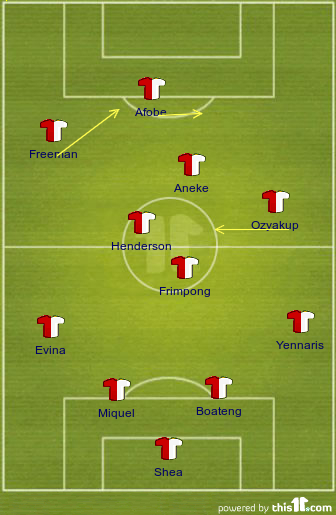 They lined up in a 4-3-3, but as the graphic shows, with Ozyakup drifting in, it was more like a 4-1-2-1-2. Freeman played on the left, but drifted in in the second half, and got more involved.
Arsenal pressed up high on the pitch, and started to dominate after going behind. Nottingham Forest had trouble getting out of their own half, and Arsenal were on the brink. They did, when a long pass from Henderson played in Afobe, and he scored after a rebound and pass from Freeman. Chucks Aneke, who reminded me of Abou Diaby and had an imperious game, played in Afobe for the second.
Ozyakup had a very good game, and it was his pass that led to the penalty won by Afobe. Freeman put away a second penalty and after Forest made it 4-3, Freeman ended the game with his second after a cross from Henderson.
Aneke, Afobe Ozyakup, Frimpong, Freeman and Miquel were all impressive, and I'm looking forward to seeing them in the Carling Cup.
For more on the youth team, check out younggunsblog.co.uk
Arsenal Under 18's captured the Premier Academy League title on Monday (Silverware!) after a 5-3 victory over Nottingham Forests' Under 18's. The played like an Arsenal team, attacking well, and defending poorly.
Arsenal pressed up high on the pitch, and started to dominate after going behind. Nottingham Forest had trouble getting out of their own half, and Arsenal were on the brink. They did, when a long pass from Henderson played in Afobe, and he scored after a rebound and pass from Freeman. Chucks Aneke, who reminded me of Abou Diaby and had an imperious game, played in Afobe for the second.
Ozyakup had a very good game, and it was his pass that led to the penalty won by Afobe. Freeman put away a second penalty and after Forest made it 4-3, Freeman ended the game with his second after a cross from Henderson.
Aneke, Afobe Ozyakup, Frimpong, Freeman and Miquel were all impressive, and I'm looking forward to seeing them in the Carling Cup.
For more on the youth team, check out younggunsblog.co.uk
Wednesday, May 12, 2010
Arsenal 4-0 Fulham

Arsenal concluded the 2009-10 season with a 4-0 victory over a disinterested Fulham, securing 3rd place and an automatic spot for next year's Champions League.
It was a good performance from Arsenal, as they dominated possession, and made 589 passes. Better finishing from Walcott and Van Persie and they would've had 6, and it was a good response to successive defeats.
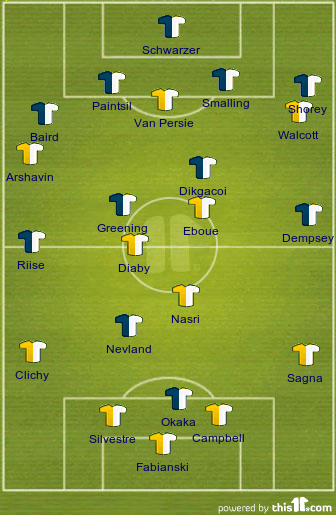
Arsenal lined up in a 4-3-3, with Samir Nasri deeper than Abou Diaby and Emmanuel Eboue, who was the most advanced midfielder. Fulham lined up in a 4-4-2, with Stefano Okaka playing higher up than Nevland, while the 2 wide midfielders, Demspey and Riise, were forced to play deeper as Arshavin and Walcott saw a lot of the ball early, and were threats. The first goal had a bit of luck about it, but the second and third goals came after great team play.
Carlos Vela and Henri Lansbury made impressive cameo's: Vela scored with an esquisite chip
after brilliant play from Lansbury, Eboue and Nasri, while Lansbury, making his senior Arsenal debut after a spell at Watford, was impressive in the centre of the midfield, only making 2 errant passes.
by Guardian Chalkboards
He played a key role in Vela's goal, and it will be interesting to see how he fits in next year.
This game had some similarites to the 4-0 victory at home v Wigan earlier this year; 4-0 victories, and also the same kind of incising passing into the box that Arsenal didn't have when they missed Robin Van Persie.
by Guardian Chalkboards
Out of all the players Arsenal missed this season, it was Van Persie who was missed the most; not only did he have 8 goals when he went down, but he also was linking up extremely well with Fabregas, Arshavin and the right sided midfielder, and it is possible that with him fit, Arsenal would've won the league, and scored 100 goals, like Chelsea did.
Also, congratulations to the Under 18's for their Title winning 5-3 victory against Nottingham Forest, and we'll have a report on that game.
Saturday, May 8, 2010
Best League In the World Series™: South America
This is the first installment of a 6 part series, talking about the most competitive league. You can find the intro here, and here's how I'll be calculating it:
First up is South America, with 10 leagues.
The Data is here, but I'll put it below.
The best league in South America, in terms of excitement is Boliva; first in competitiveness, first in goals/game, it's the most exciting, though maybe not the best quality. The worst league, in terms of excitement, is the Paraguayan league, which has the second least goals, and lowest competitive ranking.
Next up: Oceania
To find the most competitive league, I'm going to use Standard Deviation, a statistical measure of spread. It finds the spread from the mean; the lower the Standard Deviation, the more competitive league. I'll then rank each league in Standard Deviation and goals/game, add the ranks together, and divide by 2. For example, a league that ranks 15th in competitiveness, and 10th in goals/game will have a rank of 12.5 (15+10=25/2=12.5).
First up is South America, with 10 leagues.
The Data is here, but I'll put it below.
| sheet 2=database | ||||||||||||||||||||||||||||||||||||||||||||||||||||||||||||||||||||||||||||||||||||||||||||||||||||||||||||||||||||||||||||||||||||||
The best league in South America, in terms of excitement is Boliva; first in competitiveness, first in goals/game, it's the most exciting, though maybe not the best quality. The worst league, in terms of excitement, is the Paraguayan league, which has the second least goals, and lowest competitive ranking.
Next up: Oceania
Subscribe to:
Posts (Atom)